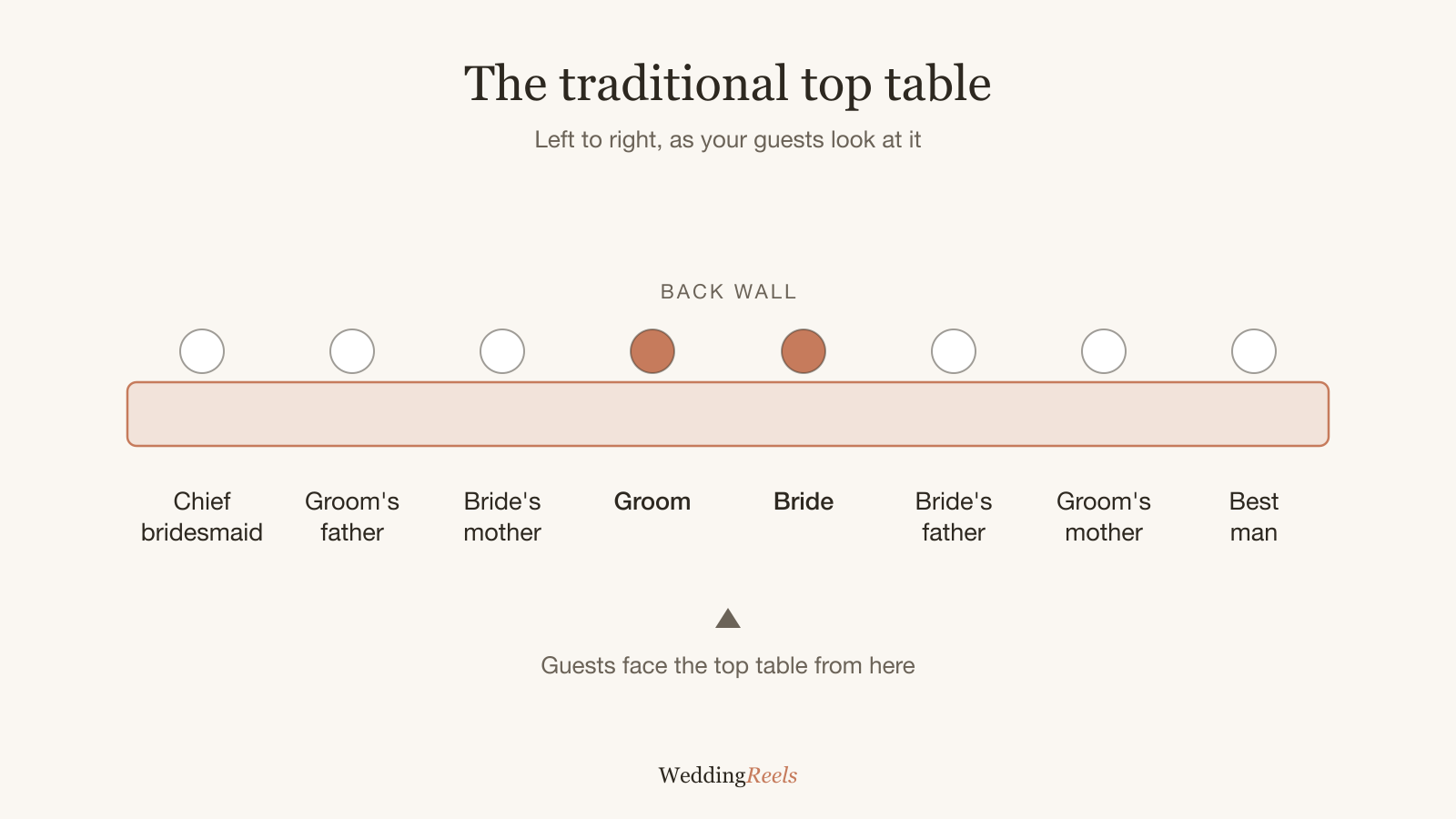
The traditional wedding top table seats eight people in one row facing the room. From your guests' left to right: chief bridesmaid, groom's father, bride's mother, groom, bride, bride's father, groom's mother and best man. Many couples now change it: a sweetheart table for just the two of them, a top table for the wedding party only, or separate tables for each set of parents.
The top table is the first thing most couples place on their seating plan, and the one most likely to cause a family discussion. Here's the traditional version, why it's arranged that way, and the alternatives couples actually use.
The traditional top table order
As your guests look at it, from left to right:
- Chief bridesmaid (or maid of honour)
- Groom's father
- Bride's mother
- Groom
- Bride
- Bride's father
- Groom's mother
- Best man
Why it's arranged that way
The order isn't random. Each parent sits next to someone from the other family, so the two families mix along the table. It also alternates men and women, which was the old etiquette for formal dinners. The best man and chief bridesmaid sit at the ends, closest to the room, because they're the ones getting up to give speeches and help out.
Once you know the logic (mix the families, keep speech-givers easy to reach), you can change the labels and keep the idea.
Modern top table layouts
Wedding party only
The couple plus bridesmaids, groomsmen and their partners. Parents get their own tables near the front, sitting with their own siblings and friends. Popular with bigger wedding parties, and with parents who'd rather be with their people.
A sweetheart table
A small table for just the two of you. It's the simplest option for blended families, you get a few minutes together during a busy day, and the photos look lovely. The downside is that it can feel a little separate, so put it close to your family's tables.
Couple and parents only
The two of you with both sets of parents, and the wedding party seated together at the next table. Works well when the wedding party is large or full of partners.
One long table
At smaller weddings, some couples skip the top table and sit in the middle of one long table with everyone. Relaxed, sociable and easy to plan.
A round top table
The couple, wedding party and partners at a large round table in the middle of the room. Everyone can talk to each other, and nobody's back is to the room. Ask your photographer first, because round tables are harder to photograph during speeches.
Divorced, separated or remarried parents
If parents don't get on, or there are step-parents to include, the traditional row gets crowded and political fast. Options that work:
- Give each parent (and their partner) their own table, equally close to yours
- Keep the top table to the wedding party and seat parents separately
- Choose a sweetheart table
Whatever you pick, tell everyone where they're sitting before the day. Our seating etiquette guide covers more of the tricky situations.
Same-sex couples
The traditional order is built around a bride's side and a groom's side, so use the logic instead of the labels. Sit the two of you in the middle, each parent next to someone from the other family, and your two best people at the ends. Many couples simply mirror it: each partner's mother beside the other partner, fathers next along, and each partner's best person at their end.
Should wedding party partners sit on the top table?
There's no fixed rule. Including partners makes for a long top table but means nobody is split from their partner for the meal. If you leave them off, seat the partners together at the nearest table, with people they know, so they're not stranded among strangers.
Where to put the top table
- Facing the room, so everyone can see you and the speeches
- Not directly in front of the speakers, or your grandparents will hear nothing but bass
- Not in front of a bright window. Backlit faces are hard to photograph, so ask your photographer
- With space behind it, so people can get in and out without everyone standing up
How long does the top table need to be?
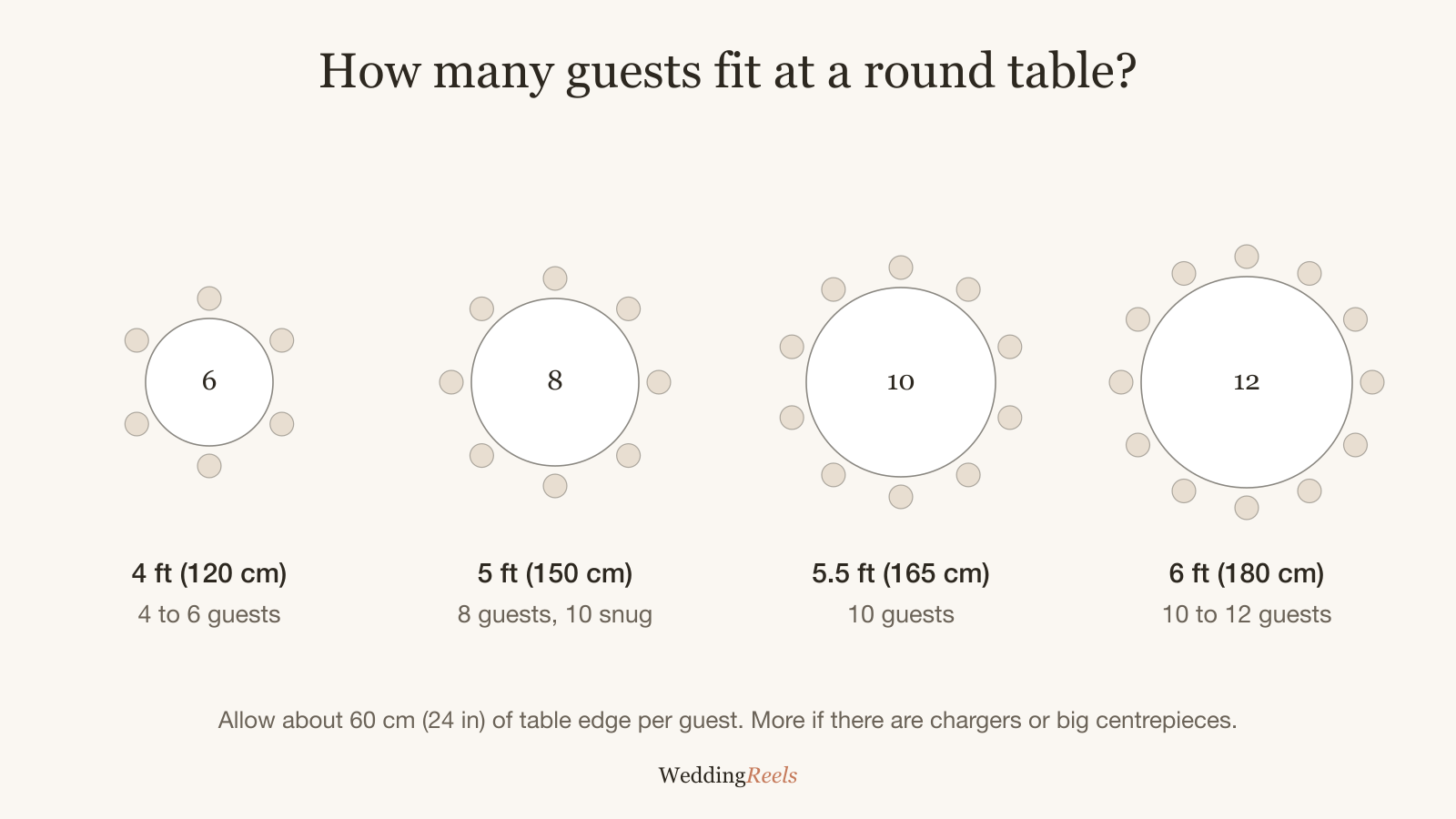
Allow about 60 to 75 cm (24 to 30 in) per person. A top table of eight needs roughly 5 to 6 metres (16 to 20 ft), often made from two or three long tables pushed together. Check with your venue that the room is wide enough, and that there's still space for the dance floor. Our guide to wedding table sizes has the details.
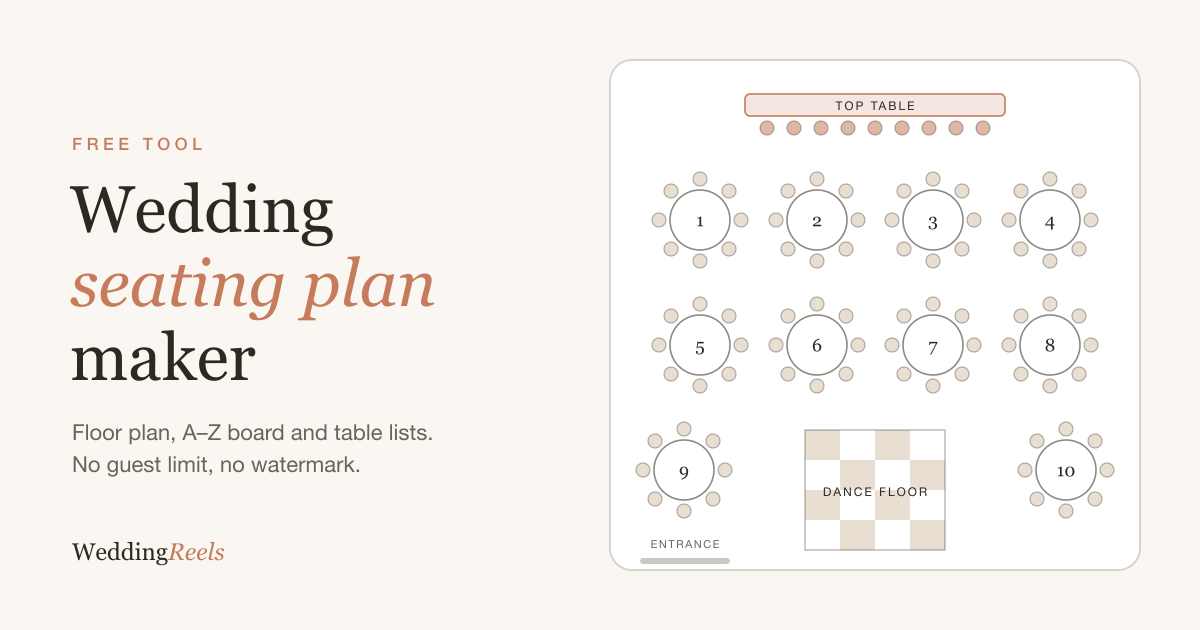
When you've decided, add the top table to your plan first. In the free seating plan maker you can add a long or sweetheart table, seat the wedding party, and build the rest of the room around it.